Weiyao Wang
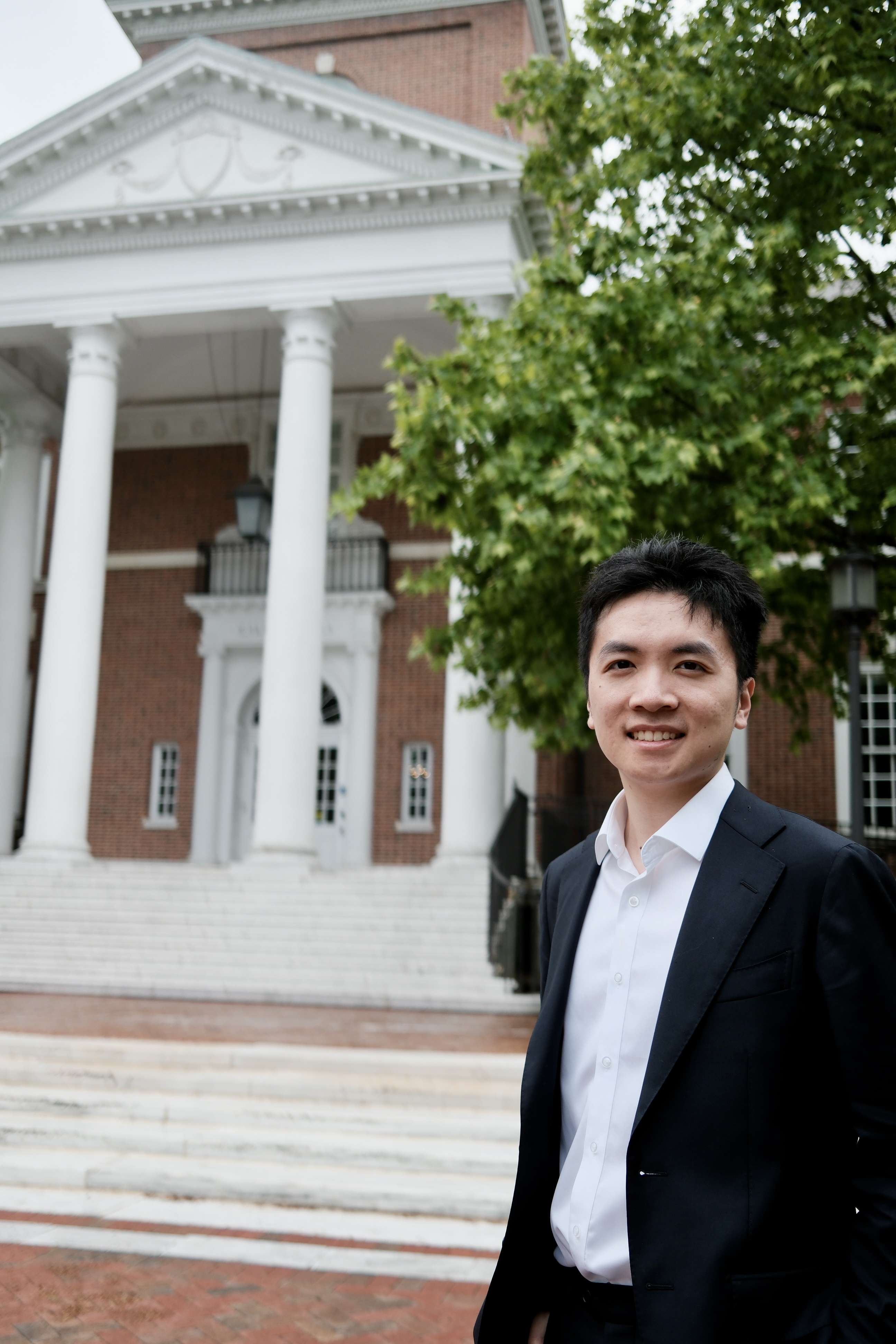
Ph.D. student @ Hopkins
Bio
I am an Applied Scientist at Amazon, working on robot manipulation. My current work focuses on training and deploying vision-language-action models for open-set tote picking, teleoperation and human-in-the-loop data curation, imitation learning, reinforcement learning fine-tuning, grasp generation and evaluation, simulation in Isaac Sim/Lab, and sim-to-real transfer.
I received my Ph.D. in Computer Science from Johns Hopkins University, where I worked with Prof. Gregory D. Hager on vision-based robotic manipulation. My Ph.D. research focused on efficient visual representations for robot manipulation, domain adaptation and sim-to-real transfer for visual policies, reinforcement learning for robotic skills, and language-conditioned robot manipulation. During my Ph.D., I also worked with Amazon, Baidu Robotics and Autonomous Driving Lab, and AKASA Inc. as a research intern.
Before my Ph.D., I completed my undergraduate studies at Duke University with a double major in Computer Science and Statistics, where I worked with Prof. Lawrence Carin on deep generative models. I also worked as a software engineering intern at Facebook and as a research intern at UC Berkeley / BAIR with Prof. Dawn Song and Prof. Bo Li on privacy in deep reinforcement learning. Before graduate school, I worked as an analyst at McKinsey & Company.
Papers in robotics, computer vision, and reinforcement learning
-
Demonstrating Multi-Suction Item Picking at Scale via Multi-Modal Learning of Pick Success
Che Wang, Jeroen van Baar, Chaitanya Mitash, Shuai Li, Dylan Randle, Weiyao Wang, Sumedh Sontakke, Kostas E. Bekris, and Kapil Katyal.
Robotics: Science and Systems (RSS), 2025. [Paper] -
VIHE: Virtual In-Hand Eye Transformer for 3D Robotic Manipulation
Weiyao Wang, Yutian Lei, Shiyu Jin, Gregory D. Hager, and Liangjun Zhang.
IEEE/RSJ International Conference on Intelligent Robots and Systems (IROS), 2024. [Project Site] [Paper] [Code] -
Adapting Image-based RL Policies via Predicted Rewards
Weiyao Wang, Xinyuan Fang, and Gregory D. Hager.
Learning for Dynamics & Control Conference (L4DC), 2024. [Paper] -
Domain Adaptation of Visual Policies with a Single Demonstration
Weiyao Wang and Gregory D. Hager.
IEEE International Conference on Robotics and Automation (ICRA), 2024. [Paper] -
Dynamical Scene Representation and Control with KP-NeRF
Weiyao Wang, Andrew S. Morgan, Aaron M. Dollar, and Gregory D. Hager.
IEEE International Conference on Automation Science and Engineering (CASE), 2022. -
Learn Proportional Derivative Controllable Latent Space from Pixels
Weiyao Wang, Marin Kobilarov, and Gregory D. Hager.
IEEE International Conference on Automation Science and Engineering (CASE), 2022. [Paper] -
How You Act Tells a Lot: Privacy-Leaking Attack on Deep Reinforcement Learning
Xinlei Pan, _Weiyao Wang_, Xiaoshuai Zhang*, Bo Li, Jinfeng Yi, and Dawn Song.
International Conference on Autonomous Agents and Multiagent Systems (AAMAS), 2019. [Paper]
Papers in medical AI, document understanding, and representation learning
-
RegCLR: A Self-Supervised Framework for Tabular Representation Learning in the Wild
Weiyao Wang, Byung-Hak Kim, and Varun Ganapathi.
Oral presentation, Table Representation Learning Workshop, NeurIPS 2022. [Paper] [Talk] -
Artificial Intelligence to Diagnose Ear Disease Using Otoscopic Image Analysis: A Review
Therese L. Canares et al.
Journal of Investigative Medicine, 2022. -
Pediatric Otoscopy Video Screening With Shift Contrastive Anomaly Detection
Weiyao Wang, Aniruddha Tamhane, Christine Santos, John R. Rzasa, James H. Clark, Therese L. Canares, and Mathias Unberath.
Frontiers in Digital Health, 2022. [Paper] -
Otoscopy Video Screening with Deep Anomaly Detection
Weiyao Wang, Aniruddha Tamhane, John R. Rzasa, James H. Clark, Therese L. Canares, and Mathias Unberath.
SPIE Medical Imaging, 2021. Oral. [Paper]
Papers in deep generative models
-
JointGAN: Multi-Domain Joint Distribution Learning with Generative Adversarial Nets
Yunchen Pu, Shuyang Dai, Zhe Gan, Weiyao Wang, Guoyin Wang, Yizhe Zhang, Ricardo Henao, and Lawrence Carin.
International Conference on Machine Learning (ICML), 2018. [Paper] -
Triangle Generative Adversarial Networks
Zhe Gan, Liqun Chen, Weiyao Wang, Yuchen Pu, Yizhe Zhang, Hao Liu, Chunyuan Li, and Lawrence Carin.
Conference on Neural Information Processing Systems (NeurIPS), 2017. [Paper] -
Adversarial Symmetric Variational Autoencoder
Yuchen Pu, Weiyao Wang, Ricardo Henao, Liqun Chen, Zhe Gan, Chunyuan Li, and Lawrence Carin.
Conference on Neural Information Processing Systems (NeurIPS), 2017. [Paper]